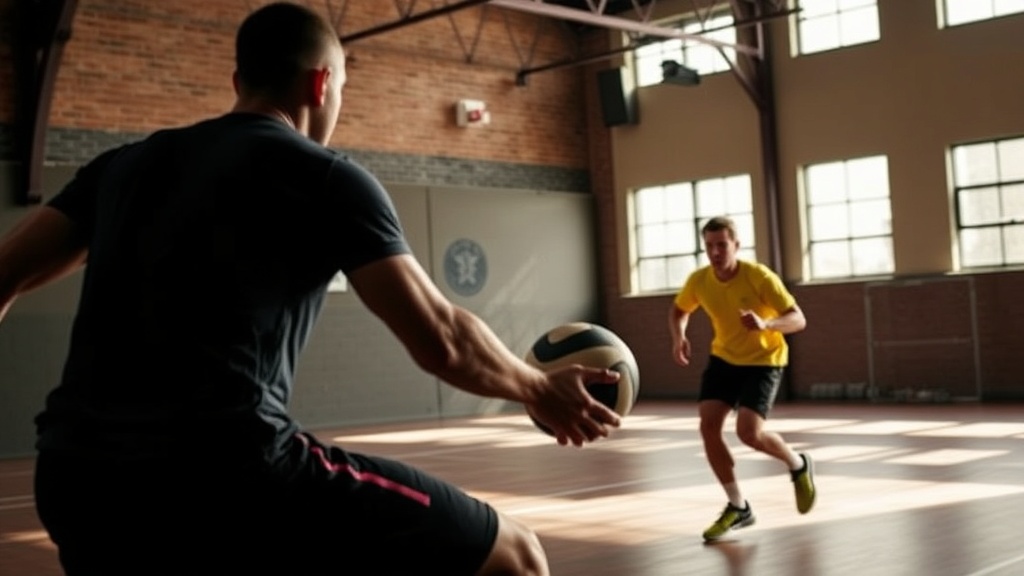
Why You Need to Train Your Lateral Movement for Dodgeball

The Mechanics of Lateral Agility in Competitive Dodgeball
This guide details the physiological necessity of lateral movement training and provides a specific regimen to improve your ability to dodge, weave, and reposition on the court. You will learn why linear speed is insufficient for high-level play, how to build explosive side-to-side power, and the specific drills required to decrease your reaction time when an incoming ball forces a sudden change in direction.
In competitive dodgeball, the most dangerous players are not necessarily the hardest throwers, but the ones who are impossible to pin down. If you only train in straight lines—running sprints or long-distance jogs—you are fundamentally unprepared for the reality of a national circuit match. A dodgeball court is a multidimensional space where the threat rarely comes from directly in front of you. It comes from the periphery, the angles, and the sudden, erratic shifts in a player's stance. To survive, you must master the lateral plane.
The Difference Between Linear Speed and Lateral Reactivity
Most athletes confuse general athleticism with dodgeball-specific agility. Linear speed is your ability to run from point A to point B in a straight line. While useful for sprinting to retrieve a ball, it does nothing to help you when a high-velocity throw is aimed at your hip. Lateral movement is the ability to shift your center of mass rapidly to the left or right to avoid an incoming projectile.
In a game setting, you are rarely running; you are shuffling, lunging, and cutting. If your training lacks lateral components, your feet will be "heavy" when a ball is thrown at an angle. This results in a late reaction, a failed dodge, and an early exit from the game. To build this, you must focus on three specific areas: eccentric strength, explosive concentric power, and neurological reaction time.
Developing Explosive Lateral Power
To move effectively, you need to be able to push off the inside edge of your foot with immense force. This requires more than just muscle; it requires the ability to recruit motor units instantly. If you want to improve your ability to dodge a shot, you must incorporate plyometrics for better dodgeball agility into your weekly routine.
1. Lateral Bounds (Skater Jumps)
The skater jump is the gold standard for developing lateral power. Stand on one leg and jump sideways as far as possible, landing on the opposite leg with a soft, controlled knee bend. The goal is not just distance, but the ability to "stick" the landing. If you wobble upon landing, your stabilizer muscles are weak. Aim for 3 sets of 10 jumps per side, focusing on the explosive push-off and the controlled deceleration.
2. Heiden Drills
Similar to the skater jump, the Heiden drill focuses on the rhythmic transition between sides. This mimics the constant shifting of weight seen during a defensive stance. Perform these in a controlled environment, moving through a series of rapid-fire lateral leaps. This builds the "twitch" required to move before the ball even reaches your mid-section.
3. Weighted Lateral Lunges
p
Standard lunges are great for general fitness, but the lateral lunge specifically targets the adductors and gluteus medius, which are the primary drivers of side-to-side movement. Hold a single kettlebell or a dumbbell at your chest (goblet style) and step wide to the side, keeping your trailing leg straight. This builds the strength necessary to push off forcefully when a ball is thrown at your periphery.
The Importance of Deceleration and Stability
A common mistake is training only the "go" and forgetting the "stop." In dodgeball, you often have to jump or lunge to avoid a ball and then immediately return to a neutral stance to prepare for the next shot. If you cannot decelerate your body weight effectively, you will over-rotate or stumble, leaving you vulnerable. This is why eccentric strength—the ability to control a muscle as it lengthens—is vital.
To improve your deceleration, incorporate the following:
- Single-Leg Romanian Deadlifts: This builds the posterior chain and ankle stability, ensuring you don't lose your footing during a sudden change of direction.
- Cossack Squats: These deep, lateral movements improve hip mobility and strength in the lengthened position, allowing for a wider range of defensive movement.
- Box Drops: Step off a small 6-inch or 12-inch box and land on both feet with perfect stability. This trains your nervous system to handle the impact of sudden weight shifts.
Strength in the lower body is the foundation, but it must be paired with a stable core to transfer that power. A weak midsection leads to "leaking" energy, meaning your legs might move fast, but your torso lags behind, making your movement clumsy. For a deeper look at how to stabilize your frame, read our guide on core strength for better power, as the same principles apply to your defensive stability.
Drills for Reactive Agility
Static strength is useless if you cannot apply it under pressure. In a match, you don't choose when to move; the ball chooses for you. Therefore, your training must include reactive drills where the movement is triggered by an external stimulus.
The Mirror Drill
Find a partner and stand facing them about five feet apart. One person is the "leader" and the other is the "shadow." The leader moves laterally, forward, and backward with unpredictable changes in direction. The shadow must mimic every movement exactly. This forces your brain to process visual cues and translate them into physical movement instantly.
The Reaction Ball Drill
Use a reaction ball (the uneven, rubberized balls that bounce unpredictably) against a wall. Throw the ball against the wall and attempt to catch it after one or two bounces. Because the ball's path is erratic, you are forced to use lateral lunges and quick footwork to reach the ball. This develops the hand-eye and foot-eye coordination necessary for dodging low-flying shots.
Cone Shuffles with Color Triggers
Set up four cones of different colors (e.g., Red, Blue, Yellow, Green) in a square pattern. Stand in the center. Have a teammate call out colors in a random order. You must sprint or shuffle to that cone and return to the center as fast as possible. This builds the cognitive processing speed required to react to a player's body language before the ball is even released.
Footwork and Stance: The Fundamentals
Even the most explosive athlete will fail if their base is flawed. If you stand with your feet too close together, your center of gravity is high and unstable. If your feet are too wide, you cannot move quickly between them. The ideal dodgeball stance is a "ready position": feet shoulder-width apart, knees slightly bent, weight on the balls of your feet, and chest up.
The "Split Step"
Just like in tennis, a subtle split step can be a game-changer. As an opponent begins their throwing motion, perform a tiny, micro-hop. This "pre-loads" your muscles, ensuring you aren't starting from a dead stop. It puts you in a state of constant readiness, allowing for an immediate lateral explosion.
Avoid "Heavy Feet"
Many players make the mistake of staying flat-footed to maintain balance. While stability is good, flat feet are slow feet. You want to be "light" on your feet, constantly making micro-adjustments. This prevents you from being caught mid-stride when a ball is thrown at a high velocity.
Recovery and Maintenance
High-intensity lateral training is taxing on the joints, particularly the ankles, knees, and hips. Because you are constantly pushing off the edges of your feet, you are at a higher risk for tendonitis and ligament strains. Do not neglect your recovery protocols.
After a heavy session of lateral drills or a high-stakes tournament, focus on mobility. Use a foam roller on your IT bands and lateral quadriceps. Ensure you are consuming enough protein to repair the micro-tears in your muscle fibers caused by explosive movements. For more on nutritional recovery, see our post on high protein diets for muscle repair.
If you feel a sharp pain in your lateral meniscus or your Achilles tendon, stop immediately. Lateral movement training is about building capacity, not pushing through injury. A single torn ligament will do more to end your season than any amount of training can help.
Summary of the Lateral Training Regimen
To see real results on the court, you cannot treat lateral movement as an afterthought. It must be a dedicated pillar of your training. Follow this hierarchy to build a professional-grade defensive game:
- Build the Foundation: Focus on lateral lunges and single-leg stability to strengthen the muscles and joints.
- Develop the Explosion: Incorporate plyometrics like skater jumps to increase your power output.
- Train the Brain: Use reactive drills like the Mirror Drill to bridge the gap between strength and reaction.
- Refine the Stance: Maintain a ready position and utilize the split step to stay light on your feet.
The next time you step onto the court, don't just watch the ball. Watch the player's hips, anticipate the angle, and be ready to move. The court is a chessboard—make sure your pieces are fast enough to keep up with the game.