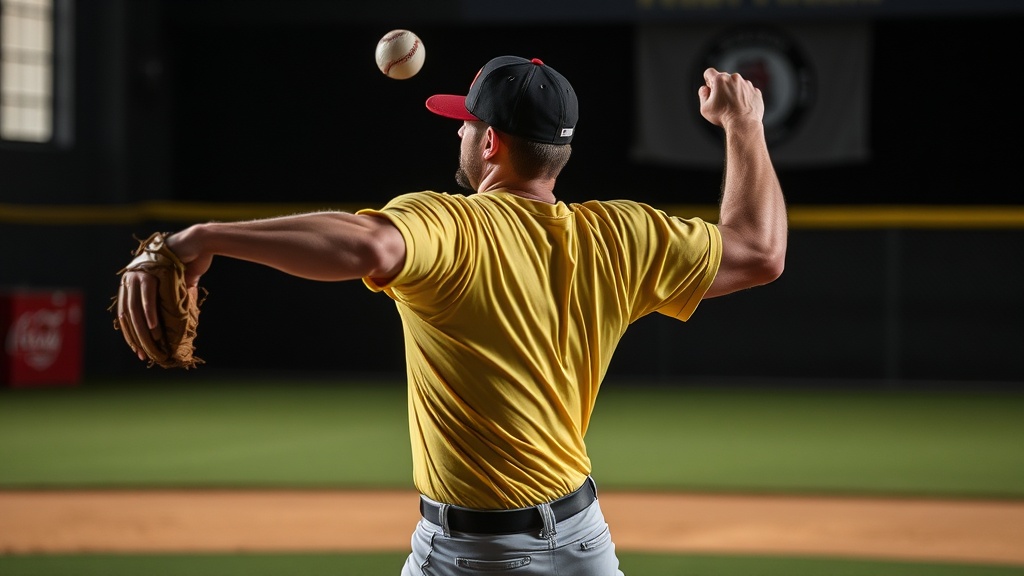
Why You Need Core Strength for Better Throwing Power

You are standing at the backline of a regulation dodgeball court. The score is 11-11. The opposing team’s heavy hitter is winding up for a cross-court heater. You step into your stance, plant your lead foot, and whip a throw. The ball leaves your hand with significant velocity, but as you follow through, your torso wobbles, your balance shifts too far forward, and the ball sails three feet wide of the target. That missed connection isn't a failure of your arm strength or your wrist snap; it is a failure of your kinetic chain. This post explains why core strength is the fundamental engine behind throwing power and how you can train it to ensure your shots remain lethal and accurate under pressure.
The Kinetic Chain: Why Your Arm is Only a Tool
In competitive dodgeball, players often make the mistake of thinking power comes from the bicep or the triceps. While those muscles are necessary for the final "snap," they are secondary to the movement of the entire body. Think of your body as a whip. The handle of the whip provides the stability and the direction, while the tip provides the speed. In this analogy, your core is the handle. If the handle is soft or unstable, the tip will whip erratically, and you will lose all precision.
The process of throwing a high-velocity ball begins with the ground. Force is generated in the legs, transferred through the hips, and funneled through the torso before finally exiting through the arm. This is known as the kinetic chain. If there is a "leak" in this chain—specifically in the midsection—the energy generated by your lower body dissipates before it ever reaches your hand. A weak core results in a loss of torque, meaning you have to work twice as hard with your arm to achieve the same ball speed, which significantly increases your risk of rotator cuff injuries.
Torque and Rotational Stability
Effective throwing requires two distinct types of core strength: rotational power and anti-rotational stability. Rotational power is the ability to rotate your torso rapidly around a central axis. This is what allows you to whip a ball across the court with devastating speed. However, if you only train for rotation, you will lack the control needed for accuracy. This is where anti-rotational stability comes in. This is the ability of your core to resist unwanted movement and stay upright during a high-intensity movement.
When you throw a hard ball, your body naturally wants to spin out of control. If your obliques and transverse abdominis are not strong enough to stabilize your spine, your upper body will drift, causing your shoulder to lag or your chest to open too early. This lack of control is why many players can throw hard in practice but lose their aim during a high-stakes tournament set. To truly dominate, you must build a core that can both generate force and control it.
The Three Pillars of Core Training for Throwers
To build a functional core for dodgeball, you cannot rely solely on standard crunches or sit-ups. Crunches primarily target the rectus abdominis (the "six-pack" muscles) through spinal flexion, which does very little to help with the rotational demands of a throw. Instead, you need to focus on three specific categories of movement: anti-rotation, rotation, and lateral stability.
1. Anti-Rotation Exercises
Anti-rotation training teaches your body to maintain a stable center while external forces are trying to pull you out of alignment. This is critical for maintaining accuracy during the follow-through of a throw. One of the most effective tools for this is the Pallof Press. Using a resistance band or a cable machine, you hold the handle at chest height and press it outward, resisting the band's attempt to pull your torso toward the anchor point. Hold the position for three seconds, then return. This builds the stability required to keep your chest squared during a heavy throw.
Another excellent drill is the Hardstyle Plank. Unlike a standard plank where you might hold a position for minutes, a Hardstyle Plank requires maximum tension. Squeeze your glutes, pull your elbows toward your feet, and tighten your core as if someone is about to punch you in the stomach. This high-intensity tension builds the neurological capacity to stabilize your spine under the sudden stress of a rapid-fire dodgeball exchange.
2. Rotational Power Exercises
Once you have the stability to control your body, you need the explosive power to drive the ball. This comes from the obliques and the deep rotational muscles. The Medicine Ball Rotational Throw is the gold standard here. Stand perpendicular to a wall, hold a 10-12 lb medicine ball at your hip, and explosively rotate your hips and torso to launch the ball against the wall. Focus on the transfer of energy from your back foot, through your hips, and into the ball. This mimics the exact mechanics of a heavy cross-court shot.
Another way to build this power is through Russian Twists with a Weighted Plate. While these are common, the key is to move with control and ensure your hips remain relatively stable while your upper torso rotates. This builds the endurance of the obliques, which is vital during long tournament days where you might be throwing hundreds of balls.
3. Lateral and Posterior Stability
A strong core isn't just about the front and sides; it's about the entire cylinder of your midsection, including the lower back. If your lower back is weak, you will experience "sagging" during your throwing motion, which kills your power. Bird-Dogs are a fundamental movement for developing this stability. On all fours, extend your opposite arm and leg simultaneously, focusing on keeping your hips perfectly level with the floor. This trains the cross-patterning of the core, which is essential for the diagonal force used in throwing.
Additionally, incorporating Side Planks will strengthen the quadratus lumborum and the lateral stabilizers. A strong lateral chain ensures that when you lunge to the side to dodge a ball and immediately transition into a throw, your body remains upright and ready to exert force. Strengthening these areas is also a great way to improve your throwing accuracy with shoulder stability, as a stable core provides a solid foundation for the shoulder to operate from.
Integrating Core Training into Your Routine
You should not treat core training as an afterthought at the end of a workout. If you are exhausted, your form will break down, and you won't get the stimulus required for growth. Instead, integrate these movements into your functional training sessions. For example, on a strength day, perform your heavy lifts (like deadlifts or squats) first, then follow up with your rotational power work, and finish with your anti-rotation stability drills.
A sample weekly core-focused routine for a competitive player might look like this:
- Monday (Explosive Power): Medicine Ball Rotational Throws (3 sets of 8 reps per side), Russian Twists (3 sets of 20 reps).
- Wednesday (Stability & Control): Pallof Press (3 sets of 12 reps per side), Bird-Dogs (3 sets of 15 reps), Deadbugs (3 sets of 20 reps).
- Friday (Endurance & Tension): Hardstyle Plank (4 sets of 45 seconds), Side Planks (3 sets of 45 seconds per side).
As you progress, do not just add more reps. Add more resistance or more speed. If the medicine ball feels light, move to a heavier one. If the Pallof Press is easy, use a thicker resistance band. The goal is to constantly challenge your ability to stabilize and rotate.
The Connection Between Core Strength and Longevity
Dodgeball is an asymmetrical sport. Most players have a "dominant" side that they use for throwing, which can lead to muscular imbalances over time. If your core is weak, your body will compensate for the lack of stability by overusing the small muscles in your lower back and shoulders. This is a fast track to chronic pain and injury. By building a robust, multi-directional core, you are essentially building a suit of armor for your spine.
A strong core also aids in overall recovery. When your muscles are working efficiently through the kinetic chain, you experience less localized fatigue. This is particularly important when you are playing in back-to-back tournament brackets. To support this physical demand, ensure you are fueling correctly. For example, understanding why you need a high protein diet for muscle repair will help you recover from these intense core sessions so you can return to the court at full strength.
Summary of Practical Application
To maximize your throwing power, stop thinking about your arms and start thinking about your center. A powerful throw is a full-body event that begins in the feet and is governed by the core. Implement a mix of anti-rotation for accuracy and rotational power for velocity. If you can master the ability to stabilize your torso while simultaneously exploding through a rotation, you will find that your shots are not only harder to dodge but significantly more difficult to miss. Treat your core like the engine of a high-performance vehicle: keep it strong, keep it stable, and it will deliver the power you need when the game is on the line.