Why Dodgeball Coaches Ignore AI: The Sport Where Intuition Beats Algorithms

Let's look under the hood at something that keeps getting overlooked in the AI-sports-coaching conversation.
It's March 2026. Spring sports season is spinning up, and the tech press is doing its annual thing—breathless coverage of AI coaching tools, performance dashboards, predictive analytics. NBA teams are running video analysis through neural nets. MLB front offices have more data scientists than scouts. Pro soccer clubs are feeding GPS telemetry and heart rate variability into fatigue models that tell coaches who to sub before the player even feels tired.
The money is following the algorithm. I get it. The results are real.
And dodgeball coaches—at the highest competitive levels of the ADL, the national circuits, the Bangkok Worlds contingent—are watching all of it and shrugging.
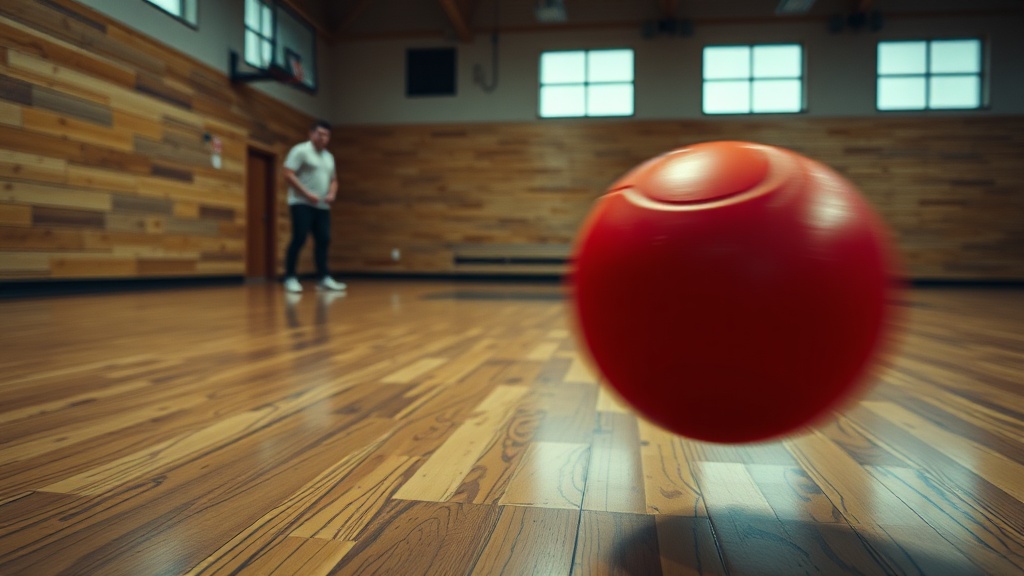
Not because they're anti-tech. Not because they don't care about winning. Because they've tried to apply the same logic to a 70mph foam sphere moving across a court with five variables in motion, and the math doesn't work.
Let me explain why.
How AI Cracked Mainstream Sports
Before I make the contrarian argument, give me a minute to be fair to the technology.
AI-assisted coaching in major sports works because those sports have a latency cushion. A baseball pitch takes roughly 400 milliseconds from release to contact. That's enough time for a trained neural network to analyze pitch trajectory, spin rate, release point, and batter tendency—and flag the data for a pitching coach to review after the at-bat. The analysis isn't real-time. It doesn't need to be. The coaching intervention happens between pitches, between innings, between games.
Same logic applies to defensive heat maps in soccer. You're not running an algorithm during a corner kick—you're reviewing it at halftime. The AI identifies that your left midfielder has a tendency to leave a 12-yard gap when tracking back against right-footed wingers. Your coach corrects it at training on Tuesday. The processing delay is irrelevant because the feedback loop is measured in hours, not milliseconds.
Basketball shot optimization? Works the same way. Possession data, shot chart analysis, pick-and-roll coverage tendencies—all post-hoc. All reviewed in the locker room. All applied over the course of a season.
The pattern is consistent across every sport where AI has made real inroads: the game is slow enough, or structured enough, that algorithmic processing delay doesn't matter. The analysis improves the next rep, not the current one.
Dodgeball doesn't have a next rep.
The Reaction Window Problem

Here's what the sports science research suggests—and I want to be clear these are estimates, not settled constants: human visual reaction time to a moving object generally runs somewhere in the range of 150 to 250 milliseconds depending on the study, the conditions, and what exactly counts as "response initiated." Call it 200ms as a rough working midpoint.
A competitive throw at 70mph travels around 100 feet per second. On a typical competitive dodgeball court, the relevant throwing distance to a live target runs somewhere between 20 and 40 feet—meaning the ball is covering that distance in roughly 200 to 400ms depending on court geometry and angle.
This means that by the time a human player has visually processed the release and begun a motor response, the ball has already traveled a significant portion of the relevant court distance.
What bridges the gap? Anticipatory pattern recognition. You're not reacting to the ball—you're reading the pre-throw sequence. Shoulder dip. Grip shift. Hip rotation. Foot plant. Weight transfer. A world-class dodgeball player has internalized thousands of hours of this data at a subconscious level, and their body initiates evasion before conscious processing even registers the throw.
Now ask yourself: what does an AI coaching system do with that?
It watches video. It labels body positions frame-by-frame. It builds a dataset of throw signatures and trains a classification model. This process takes weeks of footage, significant compute, and produces outputs that look impressive in a research paper.
And then what? You can't feed real-time video analysis to a player mid-game in a sub-300ms window. The latency of even edge-deployed computer vision systems—capturing, processing, transmitting, displaying feedback—is measured in hundreds of milliseconds minimum. That's the same window as the entire reaction sequence. The information arrives after the decision point has already passed.
AI analysis at dodgeball speed is like sending a telegram to someone who already had to cross the street. The advice was probably good. It just got there too late to matter.
What a Dodgeball Coach Actually Does
I've spent a decade watching and coaching at competitive circuits. Here's what the best coaches are doing at courtside, and none of it resembles a performance dashboard.
They're reading the player who's about to throw—not the one throwing now. They're watching for the three-second tell sequence that precedes a cross-court fake. They're tracking which of their own players has gone three throws without a read and is starting to drift in their court positioning. They're counting dead-ball inventory in their head. They're managing the emotional temperature of the bench.
This is game-state intelligence—a simultaneous awareness of maybe fifteen interdependent variables that updates every few seconds. The best coaches I've seen operate like chess players who can run twelve-move sequences in their heads, except the board is reconfiguring faster than any algorithm I've seen modeled for sports applications.
The coaching intervention at the highest level isn't "here's what the data says about your throw velocity." It's "your left wing is reading a half-step slow—get her switched to a bait role before the other team's shooters notice." That's not data. That's pattern synthesis across years of watching human beings compete under pressure.
Why Coaching Clinics Beat Software Subscriptions
The dominant knowledge transfer model in competitive dodgeball is peer-to-peer. Experienced coaches run clinics. Tape review is watched by humans with deep contextual knowledge who annotate what they see in plain English. Regional meta analysis spreads through forums and direct conversation, not algorithm outputs.
This isn't backward. This is adaptive.
Dodgeball's competitive meta evolves faster than any software training cycle could accommodate. In my observation, major tournament results ripple into domestic circuit strategy within weeks—a defensive rotation adjustment demonstrated publicly by two top teams can become the new baseline before the next regional event. Court positioning conventions that looked standard at the start of a season become exploitable by the midpoint once the right teams publish their adjustments. The meta is a living conversation between human competitors—and it moves on a timescale of weeks, not the months required to collect new data, retrain a model, and validate outputs.
Human expertise, passed peer-to-peer through clinics and direct observation, keeps pace with that evolution. A machine learning model built on last season's tournament footage is coaching against a game that no longer exists.
The Contrarian Clarification
I want to be precise here, because the easy read of this argument is "AI bad, humans good," and that's not what I'm saying.
AI is doing genuinely impressive things in sports coaching contexts where it fits. The NBA's possession modeling is legitimate. MLB pitch analytics have changed how pitchers are developed and deployed. I'm not here to be a luddite about computer vision or pattern recognition.
What I'm saying is more specific: dodgeball is a human game that operates in the latency window where algorithmic processing becomes a structural liability, not an asset. The constraint isn't that the algorithms aren't sophisticated enough. The constraint is physics. The constraint is that the decision cycle is shorter than the feedback loop.
This is actually a useful frame for any sports coach evaluating whether AI tools make sense for their context. Ask one question: does the game give you time to act on processed information? If yes, the tools probably have value. If the game moves faster than the algorithm can close the loop, you're paying for noise.
In dodgeball, the loop never closes in time. The advantage always belongs to the player with better internalized pattern recognition—and the coach who spent ten thousand hours building their own.
Trust the court reads. Build them the slow way. It's the only way that actually works.
Stay sharp, and trust your court reads.