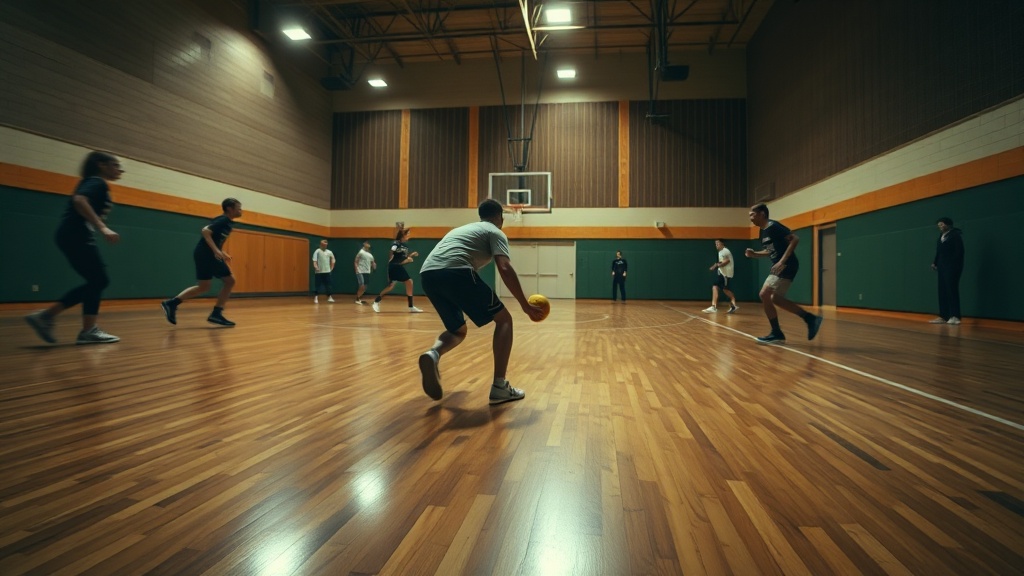
The Weak-Side Defense Problem: Why 2026 Tournament Winners Will Play Different Defense

Let's look under the hood of what's building in competitive play right now.
If you've been tracking pre-season analysis from the national circuit — scrimmage footage, coaching breakdowns, the tactical threads running through the ADL lead-up conversations — you've probably noticed a recurring theme: teams that look dominant on paper are getting exposed in the final thirds of sets during winter scrimmage play. The offense isn't always the story. The defense is — specifically, a positional gap that's been sitting in plain sight for years, and that the 2026 meta is finally forcing coaches to address before it costs them at the big tables.
It's the weak-side defense problem. And if you coach a competitive squad, this is the conversation you need to be having before the ADL opener in April, before Bangkok Worlds in December — and frankly, before your next weekend tournament.
What "Weak-Side Defense" Actually Means
Quick baseline for anyone newer to the tactical vocabulary: in a live set, weak-side defenders are the players positioned on the court side away from the primary ball action. If your opponents are loading throw sequences from the right lane, your left-side defenders are on the weak side. Simple concept.
The traditional coaching wisdom was that weak-side defenders serve two functions: (1) catch errant or redirected throws, and (2) back up the primary defenders when the action shifts. You park two players back-left or back-right, tell them to stay alert, and trust they'll rotate when needed.
That model made sense when ball speeds were lower and throw mechanics were more predictable. It does not hold in 2026 tournament play. Not even close.
Why Traditional Weak-Side Positioning Is Getting Teams Killed
Here's what changed: ball velocity, shot selection, and the dead ball sequence meta all evolved together. The average competitive throw in a high-level 2026 set isn't a lob or a chest-height drive — it's a downward-angle fastball with intentional floor skip or a flat line-drive aimed at the transition gap between zones. Neither of those is what your weak-side defenders are reading when they're planted in the traditional position.
The spacing problem. Traditional weak-side depth keeps defenders roughly 10-12 feet from the net, covering broad court width. That positioning assumes the ball trajectory is readable from catch height. It isn't — not for low skip throws that pick up irregular bounce off tournament court surfaces. By the time the defender processes the ball's skip angle, they're already moving late.
The recovery time problem. When the ball shifts from strong-side action to weak-side threat, defenders need to cover lateral distance and adjust their body angle simultaneously. Traditional positioning gives them one or the other, not both. Players end up either covering distance or getting their hands set — not both — and the catch rate drops.
The dead ball rule layering problem. This is the structural vulnerability that's been showing up in winter scrimmage footage heading into this season. Teams running the corner camp variant of the dead ball blocking sequence have been using the dead ball rule as a misdirection tool — drawing weak-side defenders toward the net to contest a near-corner threat, then firing a redirect to the now-undefended back weak-side position. Classic bait-and-punish. If your weak-side defenders are reading the dead ball sequence the old way (step up, challenge, recover), they're leaving the back corner open on the redirect. This pattern has surfaced repeatedly in national circuit scrimmage play this winter — and when the ADL bracket opens in April and Bangkok Worlds assembles the deepest field this sport has ever seen in December, coaches who haven't patched it are going to get exposed when it counts.
The Structural Adjustment: Compressed Weak-Side Triangle
The coaching community has been converging on an adjustment that addresses all three problems simultaneously. I'd call it the compressed weak-side triangle.
Instead of two defenders playing at traditional mid-depth (10-12 feet), you run one player slightly shallower — 8-9 feet, covering the near-corner dead ball bait — and a second player sitting deliberately deep, almost at the baseline, whose job is entirely different. That deep player isn't contesting throws. They're not challenging the near threat. They're positioned to cover the redirect and the corner gap simultaneously.
That deep baseline position is the tactical innovation the 2026 meta demands. In traditional positioning, no one owns the baseline-corner zone under active throw sequences because the assumption is that the dead ball rule clears it. But when your opponent is running misdirection off the dead ball bait, the baseline-corner becomes the most dangerous undefended real estate on the court. A dedicated player sitting there shuts down the redirect sequence almost entirely — not because they're faster, but because they're already there.
The Breakdown: What This Looks Like on a Court
For a coach mapping this to practice:
Standard setup (what you're probably running):
FRONT:   [P1] -------- [P2] -------- [P3]
BACK:    [P4] -------- [P5]
P4 and P5 handle weak-side coverage from mid-depth, sliding laterally as action shifts.
Compressed triangle setup:
FRONT:   [P1] ------- [P2] ------- [P3]
MID:     [P4] -- [P5]
DEEP:                       [P5-ALT]
You're not adding a player — you're repositioning your existing weak-side second. One player at compressed mid-depth covering the near-corner dead ball bait and reading redirect angles. One player sitting baseline-to-corner, covering the redirect and the back-corner gap. Catching, not contesting.
This sounds like a minor adjustment. It is not minor. It restructures what your weak-side defenders are trying to do. One player is still reactive (traditional role). One player is purely anticipatory — they're not reacting to the live throw, they're already in the spot the throw is going.
Why This Works: Trajectory Prediction Over Reaction
The deeper tactical principle here is something I've been watching evolve in this sport for three years: the best teams are shifting from reaction-based defense to prediction-based defense.
Reaction-based defense: I see the throw, I move to catch it.
Prediction-based defense: I know where this throw sequence goes based on positioning, angle, and the dead ball rule situation. I'm already there.
Your baseline corner player in the compressed setup isn't reacting. They're predicting. They've read the strong-side setup, recognized the dead ball bait potential, and pre-positioned for the redirect that hasn't happened yet. When the redirect fires, they're already there — not because they're faster, but because they made the read two seconds earlier.
This is why this adjustment is specifically a coaching solve, not a personnel solve. You don't need faster players. You need players who understand throw sequencing well enough to be predictive, and you need to give them permission to sit deep and not contest the near threat. That last part is counterintuitive. A player at baseline watching a near-corner throw sequence feels like they're doing nothing. They're actually doing the most important thing on the court.
Scaling This for Local League Coaches
I know most of you aren't coaching Bangkok-level squads. You're running a basement league, a regional circuit, maybe a competitive rec team that practices twice a week. Here's how this translates to your level.
Step one: diagnose your current weak-side coverage. Watch your last two practices or match recordings. Where are your weak-side defenders when action is happening on the strong side? Are they mid-depth and stationary? Are they drifting forward to contest dead ball sequences? That forward drift is the tell — it's the habit that gets exploited at the tournament level.
Step two: identify your prediction-capable player. You need someone who watches the court as a system, not as a ball-chaser. In most squads, this is your veteran player who everyone says "has good instincts." What they actually have is throw-sequence literacy. They know where the ball tends to go based on what they see. That player goes deep on weak side.
Step three: run the "sit deep" drill. Set up the misdirection sequence deliberately in practice — dead ball bait near-corner, redirect to back weak-side. Run it until your baseline player stops getting surprised by the redirect and starts being in position before the throw. When they can call the redirect before it fires 60% of the time, you've built the read into their instincts.
Step four: manage the psychology. Your deep baseline player will feel useless during sets where the redirect doesn't come. That's okay. Talk through it. The value isn't in every catch — it's in the coverage that forces your opponent to abandon the sequence because they can see the position is covered. Presence deters. Deterred sequences mean your opponent is running less optimal offense. That's a win even when the catch never happens.
What to Watch For When ADL and Bangkok Run
Here's where this gets interesting from a fan and analyst perspective. The ADL inaugural season opener in April is going to be the first real stress test — every team that's been running pre-season positioning adjustments against squads that haven't. Bangkok Worlds in December is where the full national coaching infrastructure collides under bracket pressure.
Watch the weak-side positioning on the dead ball sequences. Teams that come in still running traditional two-back mid-depth weak-side are the teams that are going to get bait-and-punished in the back half of bracket play. Teams running compressed triangle with a dedicated baseline-corner player are going to look like they have better personnel — they don't. They have better positioning.
The misdirection sequence will be the tell. If you're watching a set and trying to diagnose why a team is losing, rewind to the moment the action was on the strong side. Where was the weak-side second? If they were drifting forward toward a near-corner dead ball contest, you found your answer before the redirect was even released.
The Meta Will Keep Evolving
A prediction: by mid-summer, you'll start seeing counter-adjustments to the compressed triangle. Offense adapts — it always does. The next move will probably involve exploiting the compressed mid-depth player who's now covering both near-corner challenge and redirect reading simultaneously. That's a wide coverage responsibility, and it creates a different gap.
But right now, in March 2026, teams still running traditional weak-side positioning are heading into this season with exploitable real estate on the court. The winter scrimmage circuit has been showing the blueprint. The ADL opener will run it in real-time in April. The coaches adjusting now are going to win sets they wouldn't have won a season ago.
The court is a chessboard. Every position tells your opponent what's available and what isn't. Your weak-side defense is communicating something right now. The question is whether it's communicating coverage or vulnerability.
Figure out which one it is before Sunday.
Happy hunting, but watch the caps.