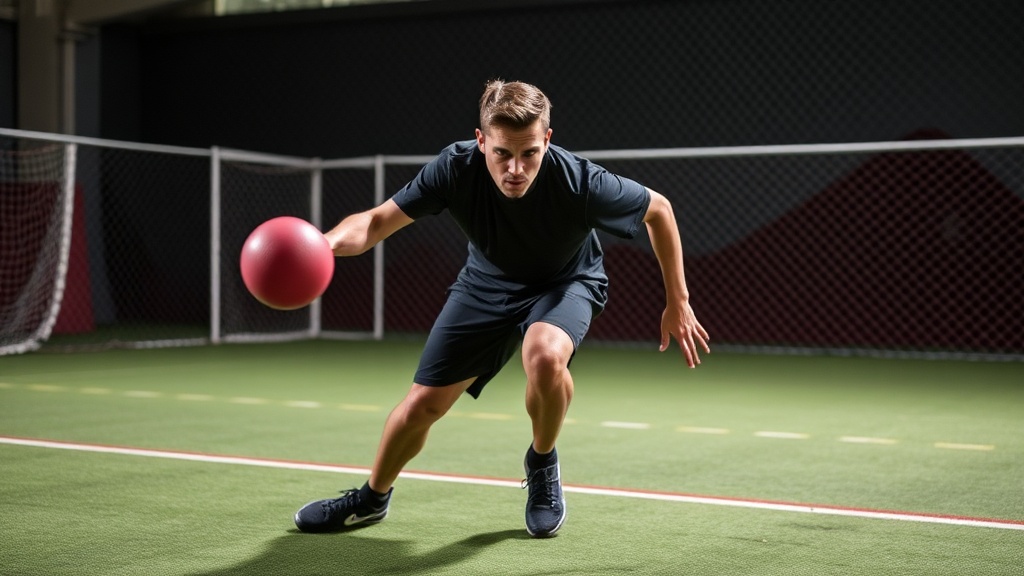
The Complete Dodgeball Training Guide: Build Speed, Power, and Agility

What muscles do you use in dodgeball?
The short answer: nearly all of them. Dodgeball demands explosive lower-body drive, rotational core strength, and whip-like arm mechanics that start in the hips and finish through the fingertips. A serious player isn't just "athletic"—the court rewards specific movement patterns that show up again and again in high-pressure moments. The quadriceps and glutes fire every time a player dives left or explodes off the baseline. The obliques and transverse abdominis rotate the torso during overhand throws. Even the calves and anterior tibialis matter—they control the quick stops and direction changes that separate caught balls from outs.
Here's the thing: most gym-goers train muscles in isolation. (Bicep curls look great on Instagram, but they won't save a player on the court.) Dodgeball is a chain-reaction sport. A throw's power flows from the back foot, through the hips, across the core, down the shoulder, and out the arm. Weak links break that chain. That said, training should emphasize compound movements—squats, deadlifts, medicine-ball rotations, and pull-ups—over machine work. The lats and rear deltoids, often ignored, decelerate the arm after release and prevent shoulder impingement. Don't skip them.
How do you train agility for dodgeball?
Agility in dodgeball comes down to one skill: stopping on a dime and re-accelerating without hesitation. Ladder drills and cone shuffles build the neural pathways, but the real magic happens when a player reacts to an unpredictable stimulus. A coach—or a training partner—should call out directions randomly during drills. (If every cut is pre-planned, the brain checks out.) Set up four cones in a square, five yards apart. Sprint to cone one, backpedal to center, shuffle to cone two, drop into a burpee, then sprint to cone three. Repeat for forty-five seconds. Rest ninety seconds. Do six rounds.
The catch? Footwear matters more than most people think. A polished gym floor isn't a grass field, and basketball shoes often grip too hard—players stick, then torque a knee. For indoor court play, the Nike Metcon 9 or Reebok Nano X3 offer flat, stable bases and just enough lateral support for violent cuts without feeling clunky. Some national-circuit veterans swear by volleyball shoes like the ASICS Gel-Rocket 11 for the low profile and gum rubber outsole.
Worth noting: agility isn't only physical. Vision training—tracking multiple balls while peripheral threats close in—separates good players from great ones. Try the "three-ball juggle" drill. Bounce two rubber balls against a wall while a partner rolls a third ball at your feet. Catch and return the wall balls without getting hit by the ground ball. It sounds ridiculous. It works. Studies on reactive agility from ACE Fitness back up the idea that decision-making speed beats raw sprinting speed in court sports.
What's the best way to build throwing power for dodgeball?
Harder throws come from better sequencing, not bigger biceps. The goal is to teach the body to load the back hip like a spring and unload it in a tight, rotational window. Start with medicine-ball work. Stand perpendicular to a cinderblock wall, hold a six- or eight-pound ball at the outside hip, and fire it into the wall with a step-and-throw motion. Catch it on the rebound, reset, repeat. Do three sets of ten per side, twice a week. This builds the exact rotational pattern a dodgeball throw uses—without the wear and tear of throwing hundreds of actual balls.
Next, add weighted-ball throwing. Use a seven-ounce yellow ball for overload sets (builds arm strength) and a four-ounce ball for underload sets (trains arm speed). Alternate them in a progression: ten heavy throws, ten regular throws, ten light throws. The contrast effect tricks the nervous system into recruiting more motor units during the regular throws. Many elite players—especially those with baseball or softball backgrounds—already know this method. (It works for dodgeball too.)
Velocity also depends on grip and release. A four-seam grip, fingers spread across the ball's seams, creates backspin and a straighter trajectory. The release point should be out in front of the lead shoulder—not beside the ear, not low across the body. Film the throw from the side. If the elbow drops below the shoulder at release, that's a ticking time bomb for the ulnar collateral ligament. Fix it early.
What should a weekly dodgeball training schedule look like?
A balanced week mixes strength, conditioning, skill work, and recovery. Most competitive players can't train full-time—they have jobs, classes, and lives—so efficiency wins. Here's a sample four-day split that hits every base without burning anyone out:
| Day | Focus | Key Work | Duration |
|---|---|---|---|
| Monday | Lower Body + Agility | Box squats, lateral bounds, cone drills, sled pushes | 60 min |
| Tuesday | Throwing + Skill | Med-ball rotations, weighted-ball throws, target practice, catching reps | 75 min |
| Wednesday | Active Recovery | Light jog, dynamic stretching, foam rolling, visualization | 30 min |
| Thursday | Upper Body + Core | Pull-ups, dumbbell rows, Pallof presses, Turkish get-ups | 60 min |
| Friday | Conditioning | Interval sprints, Rogue Echo Bike sprints, suicide shuttles | 40 min |
| Saturday | Scrimmage | Full-court games with live dodgeballs | 90 min |
| Sunday | Full Rest | Sleep, eat, hydrate, repeat | — |
The catch? Volume isn't the same as intensity. A sixty-minute session with focused intent beats two hours of mindless reps. On throwing days, stop when velocity drops off by more than ten percent—that's the nervous system waving a white flag. Pushing through it teaches bad mechanics and invites injury. On conditioning days, mimic the sport's work-to-rest ratio. A typical dodgeball point lasts thirty to forty-five seconds, followed by a reset of similar length. Program intervals accordingly: thirty seconds all-out, thirty seconds rest, for ten to fifteen rounds.
How do you avoid common dodgeball injuries?
The most common dodgeball injuries—shoulder impingement, ankle sprains, and finger dislocations—are almost always preventable with targeted prep and smart load management. Shoulders take the biggest beating because dodgeball throws are high-velocity, high-repetition, and often performed when fatigued. A simple prehab routine—band pull-aparts, external rotations with a light dumbbell, and scapular push-ups—takes eight minutes and pays enormous dividends. Do it before every throwing session. No exceptions.
Ankles roll when players land on the edge of a shoe or catch a ball while off-balance. Single-leg balance work on an Airex pad or foam surface trains the proprioceptors to fire faster. Add single-leg Romanian deadlifts for hamstring and glute control. Strong glutes stabilize the knee and ankle during cutting. Weak glutes send all that force into the ligaments instead.
Finger injuries usually happen on catches. The "claw" catch—grabbing the ball with fingers spread wide—exposes the proximal interphalangeal joints to hyperextension. Teach the "pocket" catch instead: let the ball sink into the palms, fingers relaxed, and clamp down with the whole hand. It feels less secure at first. It isn't. With reps, the pocket catch becomes faster and safer. For players dealing with chronic finger issues, athletic tape or Buddy Loops offer cheap insurance.
Recovery isn't soft—it's strategy. Sleep seven to nine hours. Eat one gram of protein per pound of body weight. Hydrate before thirst hits. And if something hurts for more than a week, see a professional. The STOP Sports Injuries campaign offers excellent resources on overuse prevention for court athletes.
What gear actually matters for dodgeball training?
Not much—but what does matter, matters a lot. A quality dodgeball (the 8.5-inch rubber balls used in most competitive leagues) should be the first purchase. Training with underinflated playground balls teaches bad habits. The real ball is smaller, denser, and moves faster. Get used to it.
For strength work, a set of resistance bands—TRX Strength Bands or similar—opens up dozens of rotational and shoulder exercises that dumbbells can't replicate. A six-pound medicine ball and a ten-pound medicine ball cover most throwing drills. A jump rope (any cable speed rope will do) warms up the calves and ankles in two minutes flat.
Here's the thing about apparel: court floors are slippery when dusty, and sticky when humid. Knee pads aren't mandatory, but anyone who dives regularly—especially on hardwood or sport court—should consider the McDavid Hex Knee Pads. They stay put, don't bulk up the silhouette, and save skin. Court shoes, as mentioned earlier, outrank everything else. Don't run a race in flip-flops. Don't play dodgeball in running shoes.
"The players who win nationals in November aren't the ones who trained hardest in October. They're the ones who trained smartest in July." — Common refrain on the competitive circuit
Dodgeball rewards the prepared. Speed gets a player out of trouble. Power puts opponents on the back foot. Agility turns close calls into highlight reels. But none of it happens by accident. Train the right muscles, throw with proper sequencing, protect the joints, and respect the recovery process. The court is a chessboard—and the pieces that move best are the ones that trained for it. For more on sport-specific conditioning principles, check out the resources at the National Strength and Conditioning Association.