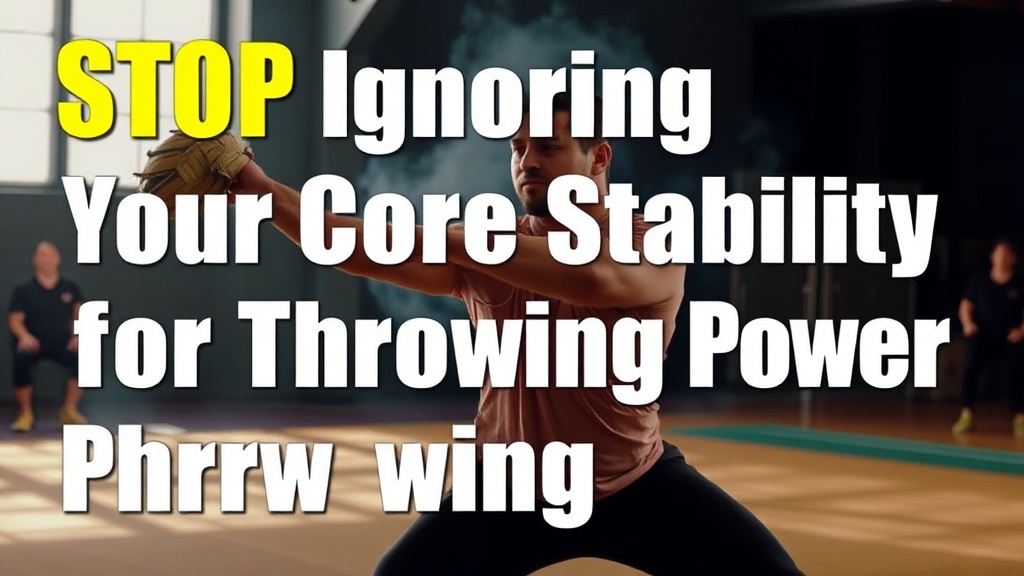
Stop Ignoring Your Core Stability for Throwing Power

Most players think power comes from the arm. They spend hours drilling the perfect release or trying to grip a ball harder, thinking that's where the velocity lives. They're wrong. If you're relying solely on your shoulder and elbow to generate speed, you're building a house on a foundation of sand. Real, sustained throwing power starts in the midsection. Without a stable, reactive core, your kinetic chain is broken before the ball even leaves your hand.
This isn't about having six-pack abs for the sake of aesthetics. It's about rotational stiffness and the ability to transfer energy from your lower body through your torso and into your extremities. When your core is weak or unstable, energy leaks. You lose force during the transition from your stride to your throw, which results in slower shots and, more importantly, unnecessary strain on your smaller joints. We're looking at the engine room here, not just the exhaust pipe.
Does a Strong Core Actually Increase Throwing Velocity?
The short answer is yes. Think of your core as the bridge between your legs and your arms. When you step into a throw, your lower body generates massive amounts of ground reaction force. That energy has to travel up through your hips, into your torso, and finally out through your arm. If your trunk is soft or unstable, that energy dissipates. It's like trying to throw a heavy object while standing on a pile of cushions—you'll never get the same snap.
In competitive play, you're rarely in a perfect, static position. You're dodging, lunging, and throwing from awkward angles. A stable core allows you to maintain structural integrity even when your balance is compromised. This stability creates a platform for your limbs to move around. If your midsection can't handle the torque generated by your hips, your nervous system will actually limit your output to prevent injury. You've essentially hit a governor on your own speed because your body doesn't trust your trunk to hold up.
The Role of Rotational Stiffness in the Kinetic Chain
Rotational stiffness is the ability of your core to resist unwanted movement while simultaneously facilitating controlled rotation. During a high-velocity throw, you need to be able to whip your upper body around while your pelvis stays anchored. This creates the "stretch-shortening cycle" that professional athletes rely on. If you can't hold that tension, you're just a person swinging their arm rather than a cohesive machine.
To build this, you need to move beyond basic planks. A plank is fine for a beginner, but it doesn't prepare you for the chaotic movement of a dodgeball court. You need to train your body to stay stiff under load and during rotation. This involves anti-rotation, anti-extension, and anti-lateral flexion drills. You want to train your core to react to the sudden shifts in weight that happen when an opponent throws a heater at your feet.
What Are the Best Exercises for Throwing Power?
If you want to see actual results on the court, stop doing endless crunches. Crunches are a vertical movement; dodgeball is a rotational sport. You need exercises that mimic the demands of the game. Here are three categories of movement you should be integrating into your weekly training regimen:
- Anti-Rotational Drills: The Pallof Press is a staple for a reason. It teaches you to resist being pulled out of alignment. If you can't hold your ground against a cable or a band pulling you sideways, you won't hold your ground when you're lunging for a shot.
- Rotational Power Drents: Medicine ball rotational throws are your best friend. These aren't just about throwing the ball; they're about the sequence of the movement. Start with the feet, move through the hips, and let the core whip the ball. This builds the explosive capacity needed for that sudden, snapping throw.
- Lateral Stability: Side planks and heavy carries. Moving through the lateral plane is often where players fail. If your side-body is weak, your ability to change direction and throw from a lunge is compromised.
For more detailed physiological breakdowns on how rotational force works, check out the resources at the National Strength and Conditioning Association. They provide deep dives into how force is transferred through the human body.
How Can I Improve My Core Stability at Home?
You don't need a full gym to start fixing your foundation. Most of the fundamental movements can be done with minimal equipment. A heavy backpack, a single kettlebell, or even a resistance band can replace high-end gym machinery. The goal is to introduce resistance that forces your core to react and stabilize.
Try implementing a "weighted carry" routine. Grab something heavy—a sandbag, a heavy plate, or even a gallon of water—and walk with it. This forces your entire midsection to stabilize your spine against an uneven load. It's a practical way to build the functional strength that translates directly to the court. When you're tired in the third set of a tournament, this is the kind of strength that keeps you upright and ready to react.
If you're looking for specific movement patterns, the Penn Medicine sports medicine articles often discuss the importance of core-to-extremity power transfer. Understanding the medical side of how your muscles work together can help you approach your training with a more clinical mindset.
Common Mistakes in Core Training
The biggest mistake I see is people training for aesthetics rather than function. A shredded midsection looks great in a mirror, but it's useless if it can't stabilize a heavy load. Don't just chase the burn; chase the stability. If you're doing a core exercise and your lower back is arching or you're feeling it in your hip flexors rather than your abs, you're doing it wrong. Stop, reset, and focus on the tension.
Another mistake is neglecting the posterior chain. Your core isn't just your front abs; it's your back, your obliques, and your glutes. If you only train the front, you'll develop an imbalance that leads to injury. You need a 360-degree approach to build a trunk that can withstand the torque of a high-velocity throw. A strong back is just as important as a strong front when it comes to maintaining your posture during a long tournament day.
| Exercise Type | Primary Benefit | Example Drill |
|---|---|---|
| Anti-Rotation | Prevents energy leaks | Pallof Press |
| Rotational Power | Incresases shot speed | Medicine Ball Slams |
| Lateral Stability | Improves change of direction | Side Plank with Leg Lift |
| Anti-Extension | Protects the spine | Dead Bug |
Focus on quality over quantity. It's better to do five perfect, high-tension reps than twenty sloppy ones. When you're on the court and the game is on the line, you need to know that your body can handle the load you're asking it to pull. Build that foundation now, or pay for it later with a sore back or a weak arm.