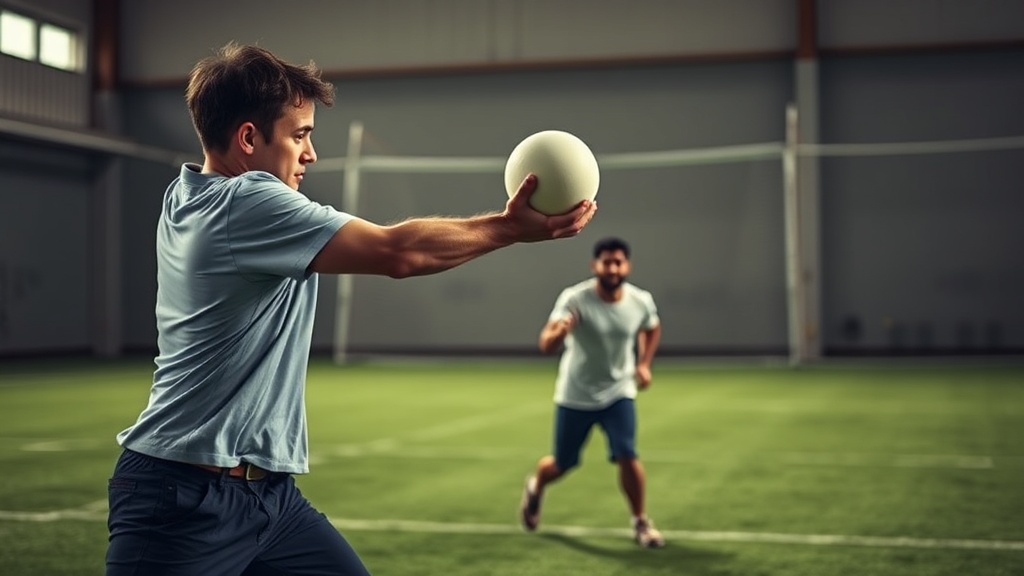
Master the Perfect Dodgeball Throw: Power & Accuracy Guide

This guide breaks down the mechanics behind powerful, accurate throws—the kind that win tournaments and make defenders flinch. In dodgeball, throwing separates casual players from competitors. The right technique adds 15-20 mph to release speed while keeping shots on target. Whether you're playing in a Wednesday night rec league or prepping for the USA Dodgeball Nationals, these principles apply.
How do you throw a dodgeball with maximum power?
Maximum power comes from hip rotation and kinetic chain transfer—not just arm strength. Start with feet shoulder-width apart, weight back, then explode through the hips while snapping the wrist at release. The arm is just the delivery mechanism; your legs and core generate the real velocity.
Think of it like a baseball pitcher (minus the Tommy John surgery risk). The sequence matters: back foot pivots, hips open, shoulders follow, elbow leads the hand, and the wrist snaps last. When done right, you'll feel the ball "pull" your arm through the motion rather than forcing it.
The stance sets everything up. Right-handed throwers should point their left shoulder toward the target—almost perpendicular to where you're aiming. This creates torque. As you begin the motion, your front hip drives toward the opponent while your back hip resists briefly. That stretch-shortening cycle stores energy like a rubber band.
Here's the thing: most players arm-throw. They stand facing their target flat-footed and whip their arm forward. That caps velocity around 50-55 mph. Elite throwers—guys who play for the WADA (World Amateur Dodgeball Association) circuits—use full-body mechanics and hit 70+ mph regularly. The difference isn't strength. It's sequencing.
Worth noting: overthrowing kills accuracy. You want about 85% max effort on competitive throws. Anything harder and your release point becomes inconsistent. Save the 100% rockets for desperation moments when precision matters less than intimidation.
What grip works best for dodgeball accuracy?
The three-finger grip—index and middle fingers on top, thumb supporting underneath—delivers the most consistent release point for hitting targets. Your ring and pinky fingers stabilize the back of the ball without applying pressure that could tilt the spin.
Hand size matters. Players with smaller hands might prefer a two-finger grip (index and thumb only) to maintain control on 8.5-inch rubber balls used in most leagues. Bigger hands can use a modified three-finger where the middle finger sits in the center seam. Experiment during warm-ups until the release feels automatic.
Pressure is the silent killer of accuracy. Grip too tight and the ball rolls off your fingers inconsistently. Too loose and you lose control on windy throws (or when you're tired late in a match). Aim for a "firm handshake" pressure—confident, not crushing. The catch? Finding that sweet spot takes reps. Hundreds of them.
Finger placement affects spin. For a straight bullet throw, fingers should stay behind the ball through release. If your fingers drift to the side, you'll cut the ball unintentionally and watch it sail wide. Some elite players actually align their fingers with the ball's panels—like a quarterback finding the laces—to ensure consistent rotation.
Speaking of equipment: the Sportime UltraFoam balls used in many school programs feel different than the rubber competition balls from Rhino Skin or Gator Skin. Practice with whatever you'll compete with. The surface texture changes grip requirements significantly.
What's the difference between a curveball and a knuckleball in dodgeball?
A curveball spins laterally and breaks sideways—usually 6-12 inches of movement—while a knuckleball has minimal spin and moves unpredictably due to air resistance. Both serve specific tactical purposes that straight throws can't match.
The curveball works best when defenders camp behind teammates or hug the sideline. Right-handed throwers create outside break by releasing with fingers pulling down the left side of the ball (like turning a doorknob counterclockwise). The key is maintaining arm speed—deceleration telegraphs the pitch and gives defenders time to adjust.
Knuckleballs are chaos weapons. You throw them with the same arm action as a fastball but "push" the ball rather than snapping your wrist. The result? A ball that flutters, dips, and sometimes knuckles straight before dropping suddenly at the end. Defenders hate them because there's no spin to track early.
That said, knuckleballs are high-risk. When they don't knuckle—when the spin is just slightly off—they become batting practice fastballs down the middle. Use them sparingly, ideally when you have a numbers advantage and can afford a miss.
How do different throw types compare in competitive play?
| Throw Type | Speed | Accuracy | Best Used When | Difficulty |
|---|---|---|---|---|
| Bullet (Fastball) | 65-75 mph | High | Open targets, quick releases | Beginner |
| Curveball | 55-65 mph | Medium | Defenders behind cover | Intermediate |
| Knuckleball | 50-60 mph | Low | Unpredictable late movement | Advanced |
| Bounce Shot | 60-70 mph | Medium | Low targets, foot shots | Intermediate |
| Change-up | 35-45 mph | Very High | Catching aggressive players off-guard | Advanced |
The bounce shot deserves special mention. In most league formats (including USA Dodgeball rules), a ball that hits the ground before contacting a player doesn't count as a hit—it eliminates the thrower if caught. But foot shots are nearly impossible to catch, and the bounce makes timing difficult. Elite players throw bounce shots with topspin so the ball "skips" upward into shins and knees rather than dying in the carpet.
How can you improve throw accuracy under pressure?
Accuracy under pressure comes from simplified decision-making and pre-shot routines that survive adrenaline dumps. Pick a target—specifically, a panel on the ball you're holding or a spot on the defender's body—before you start your motion. Don't just "throw at the guy in red."
Pressure changes mechanics. Your grip tightens. Your windup shortens. You rush. The antidote is deliberate practice that simulates game stress: set a timer for 10 seconds, have a teammate count down, or compete for consequences (loser buys post-game drinks). When you've thrown 500 reps with someone yelling "THREE... TWO... ONE...", the actual game feels manageable.
Visual tracking separates good throwers from great ones. Don't watch your target's whole body—pick a 6-inch square (chest, thigh, whatever's open) and stare through it. The eyes anchor everything else. When you look at a general area, your throw lands in a general area. When you look at a button on a jersey, you hit the button.
Footwork fixes bad angles. If you're reaching or leaning to throw, accuracy dies. Get your feet set first—even if that means taking an extra half-step. Better to release a quarter-second later with proper base than rush and sail one into the crowd. Court positioning matters too: the corner gives you angle variety, center court gives you power. Know your spots.
What equipment affects throwing performance?
The ball matters more than most players admit. Rhino Skin balls—the textured foam standard in recreational leagues—weigh about 200 grams and compress on grip. This makes them forgiving for beginners but harder to generate spin with. Gator Skin balls are slightly denser (around 220 grams) with a slicker surface that rewards clean releases but punishes grip mistakes.
Hand care is equipment too. Blisters destroy consistency. Tape problem spots before they tear. Some veterans use Mr. Grip hand strengtheners during TV time—stronger forearms delay fatigue in long tournaments. Finger tape (athletic tape, two wraps around the middle finger) adds friction without changing feel dramatically.
Shoes affect throwing more than you'd think. You need lateral stability for those quick hip rotations. Basketball shoes with wide bases (the Nike LeBron line, Adidas Harden Vol. series) work better than running shoes with narrow profiles. If your foot slides during the pivot, power leaks and shoulders open early.
The best throwers treat practice like lab work. They isolate variables. One session might focus purely on wrist snap with light tosses against a wall. Another might work on hip rotation without a ball—just shadow throws in front of a mirror. Build the mechanics separately, then integrate them. There's no shortcut around the reps, but smart reps beat mindless volume every time.
Start with the three-finger grip and a perpendicular stance. Feel your hips lead. Watch the spin. Adjust. Repeat. Eventually—probably months from now, not days—the good throws outnumber the bad ones. Then you're dangerous.