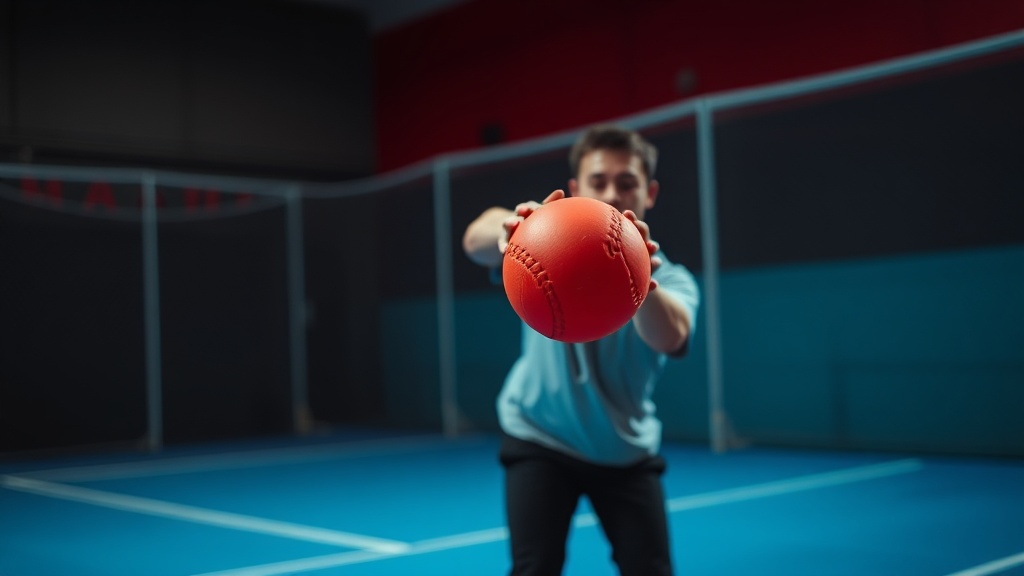
How to Throw a Dodgeball Harder and More Accurately

This post breaks down the mechanics, training drills, and equipment choices that separate recreational throwers from the competitors who control the court. Whether you're playing in a Wednesday night basement league or preparing for the USA Dodgeball Nationals, a harder, more accurate throw changes how opponents position themselves—and how your team wins points.
What's the Proper Grip for Maximum Dodgeball Velocity?
The proper grip sits the ball in your fingertips, not your palm, with the thumb providing counter-pressure on the opposite side. Most recreational players grab the ball like a grapefruit and wonder why their throws float. Here's the thing: the dodgeball rewards whip over muscle.
Start with an 8.5-inch foam ball—the standard for competitive play. Spread your fingers wide enough that you feel tension across the webbing. The index and middle fingers sit atop the ball's seam (if you're using a textured ball like the OMNI Foam Dodgeball or Gator Skin), while the ring and pinky fingers stabilize underneath. Your thumb presses directly opposite your index finger, creating a three-point pressure system.
The grip changes slightly based on ball type. Rubber balls—common in gym class variants—demand a deeper finger grip because the surface doesn't compress. Foam balls, like those used in Elite Dodgeball tournaments, allow a lighter touch. You want control without tension. Squeeze too hard and your forearm tightens. The throw loses snap.
Worth noting: hand size matters. Players with smaller hands (under 7 inches from wrist to middle fingertip) should experiment with gripping across the ball's panels rather than along them. This shortens the lever arm and creates a faster release.
How Do You Generate Power from Your Legs and Core?
Power starts in the back foot, transfers through a rotating hip, and explodes through the shoulder in a kinetic chain that multiplies force beyond what your arm alone could produce. The arm is just the delivery mechanism—the engine lives lower.
Watch a competitive thrower from the side. The motion resembles a baseball pitch minus the arm strain. The back leg loads. The hips rotate first. The shoulders follow. The arm whips last. This sequencing—lower body to upper body to arm—protects the shoulder while maximizing velocity.
Practice this sequence without a ball first. Stand sideways to a wall, back foot toward the target. Load your weight onto that back leg (roughly 70/30 distribution). Now rotate your hips toward the wall while keeping your shoulders closed. Feel the stretch across your obliques? That's stored energy. When your hips reach their rotation limit, allow the shoulders to follow. The arm comes through last, like the tip of a bullwhip.
The catch? Timing. If your arm fires before your hips rotate, you're arm-throwing. That's how shoulders get hurt. That's how throws lose speed. The best drill for sequencing is the step-behind throw:
- Stand facing 90 degrees away from your target
- Step your back foot behind your front foot (loading position)
- Rotate hips toward target
- Allow shoulders to follow naturally
- Release the ball at chest height, arm extending fully
Do this fifty times before adding a ball. The neural pathway—hip rotation before shoulder rotation—needs to become automatic. Once it is, you'll add 15-20 mph to your throw without touching a weight.
Core Training for Throwing Power
A strong core stabilizes the transfer between lower and upper body. These exercises build that connection:
- Pallof presses – anti-rotation work that mimics the resistance of a throwing motion
- Medicine ball side throws against a wall – teaches explosive hip rotation
- Russian twists with weight – builds the oblique strength that powers the whip
Twice a week. Three sets of twelve. That's enough.
What's the Release Point for Accurate Dodgeball Throws?
The optimal release point occurs when the arm extends fully at shoulder height, with the wrist snapping downward at the final moment to create backspin and a flat trajectory. Accuracy comes from consistency—same release point every throw, regardless of target distance.
Think of the arm as a lever. The longer the lever (full extension), the more speed you generate. But extension without wrist snap sends the ball high and wide. The wrist—specifically the flexor carpi radialis and ulnaris—adds the final 10-15% of velocity and determines whether the ball travels flat or arcs.
Backspin matters more than most players realize. A ball thrown with backspin (top of the ball rotating toward you) stays flatter longer. A ball thrown with topspin dives early. To create backspin, the wrist snaps down and through the ball at release. The fingers finish pointing toward the target.
Here's a drill for release point consistency: Set up a hula hoop or draw a circle on a wall at chest height. Stand fifteen feet away. Throw fifty balls, focusing only on hitting the center—not on speed. If the ball hits above the circle, you're releasing late. Below, you're releasing early. Adjust until twenty consecutive throws hit center. Then back up five feet and repeat.
That said, distance changes the release angle slightly. At fifteen feet, you throw flat. At thirty feet, you need a slightly improved release (roughly 5-10 degrees) to account for gravity's pull. The wrist snap remains identical—only the shoulder angle changes.
Target Practice Progression
| Week | Distance | Focus | Volume |
|---|---|---|---|
| 1-2 | 15 feet | Release point consistency | 50 throws/day |
| 3-4 | 20 feet | Wrist snap and backspin | 75 throws/day |
| 5-6 | 25 feet | Accuracy under time pressure | 100 throws/day |
| 7+ | Variable | Game simulation (moving targets) | 150 throws/session |
Which Dodgeball Equipment Helps Improve Throwing?
The right ball makes technique easier to learn and maintain—foam balls with grippy surfaces and consistent weight distribution provide the best foundation for developing proper mechanics. Not all dodgeballs throw the same.
Recreational players often learn on whatever the gym teacher unpacked from storage. That's fine for introductions. But if you're serious about velocity and accuracy, equipment choice matters. Here's what competitive players use:
The OMNI Foam Dodgeball (8.5-inch) dominates tournament play for good reason. The textured surface grips skin without collecting sweat, the foam density provides consistent feedback on release quality, and the weight (roughly 250 grams) sits in the sweet spot between too light (no momentum) and too heavy (slow release).
The Gator Skin Special Ball works well for training—slightly softer, more forgiving on hands during high-volume sessions. Some players keep a set of rhino-skin balls (the harder, smaller 6-inch variety) for accuracy work. The smaller target forces precision.
Footwear affects throwing more than you'd expect. Dodgeball courts—usually basketball courts with varied surface textures—demand lateral stability. The ASICS Gel-Rocket series or Mizuno Wave Lightning volleyball shoes provide the court grip and ankle support needed for explosive rotations. Running shoes with thick cushioning absorb rotational force that should transfer into the throw.
Wrist wraps or compression sleeves (like the McDavid HexPad line) help players with previous injuries maintain high-volume training. They don't add power—just stability for repeated motion.
How Can You Practice Dodgeball Throws Without a Court?
You can train throwing mechanics, grip strength, and accuracy in any open space with a wall and a rebound surface—no teammates, no court time required. Solo practice separates the players who improve weekly from those who plateau.
The wall is your best friend. Find a concrete or brick surface (avoid drywall—balls bounce unpredictably and you'll damage the wall). Stand fifteen feet away. Mark a target with tape at chest height. Now throw. The ball rebounds; you catch; you reset; you throw again. This rhythm—throw, catch, reset—builds volume faster than court play, where you might touch the ball only twenty times in an hour.
Vary the drill. One session, focus only on speed—throw as hard as form allows, even if accuracy suffers. Next session, focus only on placement—hit specific marks, sacrificing velocity if needed. The brain learns faster when you isolate variables.
Grip strength training happens away from the wall. Fill an old dodgeball with sand to roughly double its weight. Hold it at arm's length, parallel to the ground, for as long as possible. When you drop it, rest sixty seconds. Repeat five times. This builds the forearm endurance that prevents grip fatigue in late-game situations.
Finally, film yourself. Set up a phone camera at side angle. Watch the sequence: foot, hip, shoulder, arm, wrist. Does the hip rotate before the shoulder? Does the arm fully extend? Does the wrist snap? The camera reveals what proprioception misses. Professional players review footage weekly. There's no reason you can't do the same.
Consistency beats intensity. Fifty quality throws four times a week outperforms two hundred sloppy throws once. The body needs repetition to myelinate the neural pathways that make good technique automatic. Once the motion lives in your muscle memory—not your conscious mind—you'll have the harder, more accurate throw that changes how opponents play against you.
Steps
- 1
Grip the Ball Correctly for Maximum Control
- 2
Set Up Your Stance and Generate Power
- 3
Execute the Throw with Proper Follow-Through